


Research — February 13, 2026
Law judge proposes significantly lower return for Consumers Energy in Michigan

By Dan Lowrey
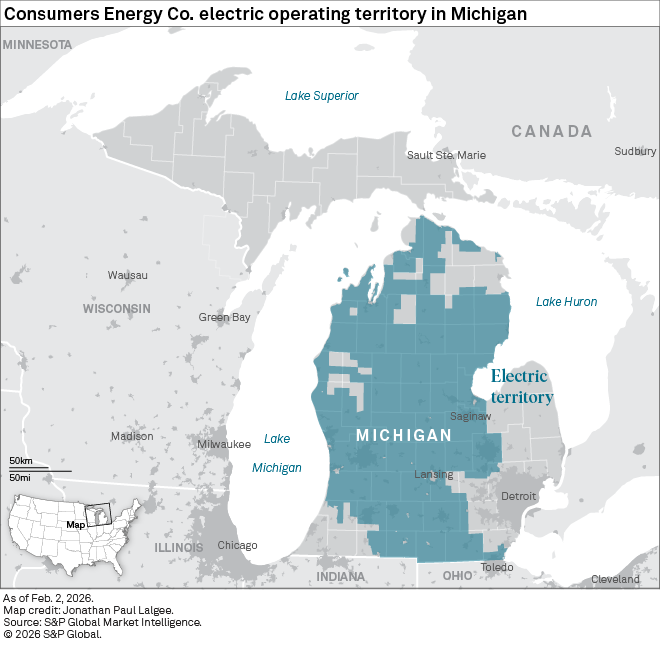
An administrative law judge with the Michigan Public Service Commission has issued a proposed decision in Consumers Energy Co.'s pending electric rate case, supporting a $168.3 million increase in electric rates or about 40% of that sought by the utility. The administrative law judge's (ALJ's) recommendation is premised upon a return on equity significantly below national averages tracked by Regulatory Research Associates.
The commission is expected to take up the matter by April after considering the parties' exceptions to the proposed decision. The company is requesting that the effective date of new rates be the later of the May 1 start of the projected test year or the date of the commission's order in this case.

➤ An ALJ with the Michigan Public Service Commission is backing a $168.3 million electric rate increase for Consumers Energy Co. (CE) — about 40% of what the company is seeking — setting up a final commission decision by April, after parties file any objections.
➤ Return on equity (ROE) is the pivotal variable in this case, and the ALJ chose a notably low figure. The ALJ's proposal is built on an 8.20% ROE, which falls well short of CE's 10.25% request and national averages for electric utilities reported by Regulatory Research Associates. The judge described the 8.20% ROE as a balanced middle ground — situated between the "utility‑comparable" return of about 9.70% and a lower standard reflecting broader market expectations of about 6.70%.
➤ RRA views the regulatory climate in Michigan as somewhat constructive from an investor perspective. In recently decided rate cases, the PSC has adopted ROEs exceeding prevailing industry averages. However, on July 31, 2024, RRA reduced Michigan's ranking regulation to Average/1 from Above Average/3 following contentious rate case decisions for the state's utilities.

The ALJ's recommended rate increase is premised on an 8.20% return on equity (42.30% of regulatory capital structure) and a 5.39% overall return on rate base valued at $15.024 billion for a test year ending April 30, 2027. The rate increase includes $76.5 million for a return on a regulatory asset attributed to CE's J.H. Campbell plant over the projected 12-month period ending April 30, 2027.
The 8.20% ROE is significantly below the 9.66% average of returns accorded to electric utilities through the first nine months of 2025. For full year 2024, the average was 9.74%. For vertically integrated electric utilities, such as CE, the average is 9.84% for the first three quarters of 2025 and was 9.70% for full year 2024. For further information regarding return on equity trends, refer to RRA's latest "Major Rate Case Decisions" report.
The recommended ROE is also 170 basis points below the utility's authorized ROE of 9.90%, which has remained unchanged since 2021. The 8.20% remains a sharp departure from ALJ rulings in CE's 2023 and 2025 electric rate cases, in which the ALJ supported ROEs of 9.80% and 9.50%, respectively. CE has requested a 10.25% ROE in this case.
"On the one hand, this [proposal for decision] finds that the results of the estimating models suggest that a reasonable ROE commensurate with the returns earned by other regulated utilities is about 9.7%. On the other hand, this PFD finds that a reasonable ROE less than the expected return earned by the riskier general market is about 6.7%. Thus, the optimal ROE which best aligns with the conflicting Supreme Court standards is an ROE of 8.2%, which is equally removed from fully complying with the standards," the law judge opined in the Jan. 29 proposed decision.
RRA calculates that differences in the rates of return account for about $191 million of the approximately $255 million revenue requirement difference between the company's supported $422.8 million increase and the judge's proposed $168.3 million increase.
RRA calculates that the judge's adjustments to rate base account for about $27 million of the $255 million revenue requirement difference in the case. And the law judge's proposed net operating income adjustments account for the remaining $36 million of the revenue requirement difference.
The law judge supported the company's request for continuation of its Investment Recovery Mechanism (IRM) through the test year and supported the company's IRM spending, with the exception of some spending associated with the Low Voltage Distribution (LVD) Repetitive Outages subprogram and recommended the removal of about $6.1 million from the annual IRM spending. About $22 million of the overall revenue requirement increase request by CE is associated with IRM distribution investments.
Regarding rate base, the law judge recommended disallowance of $28.7 million in capital expenditures in the test year for CE's high-voltage distribution (HVD) substations reliability subprogram, agreeing with arguments that capital and operations and maintenance (O&M) investments should be focused on the low-voltage distribution system. The ALJ also recommended disallowance of $27.9 million in capital expenditures targeted toward CE's fleet expansion plans, including the purchase of pickup trucks with specific upfits to perform work related to HVD operations.
Regarding net operating income items, the ALJ recommended the disallowance of $192,600 in expenses associated with incentive plan compensation to the company's top five officers, agreeing with commission staff that the expense had not been substantiated. The ALJ also recommended disallowance of $5.7 million in O&M expenses allocated to CE's LVD lines reliability subprogram, arguing that, based on dollars already spent, it was unlikely the company would spend the money in the test year.
Regarding rate design, the ALJ was supportive of CE's proposals to update Residential Advanced Metering Infrastructure Opt-Out fees and the production capacity charge; to include a facilities allowance and a Power Factor adjustment for Rate LEDR; to update new service connection fees, including a new overhead service connection fee and adjustment to the underground service connection fee; and to increase the eligibility for the Shut Off Protection Plan from 200% to 400% of the federal poverty line.
CE is a CMS Energy Corp. subsidiary.
Rate case background
CE on June 2, 2025, filed a formal rate case application seeking an increase in electric rates of $460.2 million, which includes $24.3 million that will be collected on a distribution deferral through a separate 12-month surcharge. The company's request is based on a 10.25% ROE, which exceeds national averages.
The company is requesting (in Case U-21870) a $435.9 million increase in electric base rates, which includes $77.5 million for a return on a regulatory asset attributed to the J.H. Campbell plant over the projected 12-month period ending April 30, 2027. The commission previously approved a 9% return on equity for the remaining net book value of the plant after the retirement of the coal-burning units in May 2025.
The increase is premised on a 10.25% return on equity (42.94% of regulatory capital structure) and a 6.35% return on an average rate base valued at $15.368 billion for a test year ending April 30, 2027.
The application emphasizes the importance of funding CE's Reliability Roadmap, which outlines necessary investments in infrastructure to enhance reliability amid severe weather challenges highlighted in a third-party audit. The Reliability Roadmap presents a strategy for improving reliability through four key categories of work: forestry line clearing; hardening the system to address infrastructure in poor health and at risk from severe weather impact; inspections to identify and fix failures; and digital automation that includes technological solutions to increase the efficiency of distribution planning, service restoration and line clearing. CE is also proposing a ramp-up in line clearing to achieve a five-year clearing cycle on the low-voltage distribution system, compared to the company's previous goal of a seven-year cycle. The ramp-up to a five-year cycle is planned to occur through 2031.
The company projected higher operations and maintenance expenses required to support long-term investments and ensure service reliability, along with increased financing costs to attract capital for these necessary investments.
Compliance with federal orders, such as the US Energy Department's May 23 directive to continue operating the Campbell Plant beyond May 31, 2025, adds to the financial considerations in the rate case. CE indicated it is coordinating with the Midcontinent Independent System Operator and complying with the DOE order. The costs presented in this electric rate case have not been adjusted to reflect the impacts of the DOE order. CE plans to request recovery of the costs associated with the order through a Federal Energy Regulatory Commission process.
The application also addresses the future retirement of units at the D.E. Karn coal plant, in which the company seeks to recover costs incurred for maintaining these facilities, as well as for their eventual decommissioning and the environmental responsibilities associated with the facility. The ALJ found that CE's requests for continuing regulatory asset treatment of such costs were warranted.
The application also provides funding for approved transportation electrification programs, which are centered on optimizing the charging load from electric vehicles to the benefit of all customers, and investments, incentives, programs and expenditures that are reasonably expected to increase transportation electrification in the company's electric service territory. These programs include PowerMIDrive Residential, PowerMIDrive Public Charging and PowerMIFleet.
CE is negotiating the sale of its river hydro generation fleet, which includes 13 hydroelectric dams. Should the sale fail to materialize or receive regulatory approval, the company may need to reconsider decommissioning or relicensing these assets. In its application, CE seeks to extend the deferred regulatory accounting treatment of the assets through the test year, for which the law judge had no issue.
Staff supports lower increase
On Sept. 30, 2025, staff of the commission filed testimony supporting a $322.7 million increase in electric rates, plus an additional $24.3 million for a distribution deferral to be recovered through a separate 12-month surcharge. The staff's recommendation was premised on a 9.75% return on equity and a 6.06% overall return on rate base valued at $15.205 billion and a test year ending April 30, 2027.
Subsequently, CE filed rebuttal testimony Oct. 21, 2025, supporting a $407.7 million rate increase, premised on a 10.25% return on equity (42.94% of regulatory capital structure) and a 6.30% overall return on rate base of $15.330 billion and a test year ending April 30, 2027.
The company filed revised rebuttal testimony on Oct. 29, 2025, supporting a $422.9 million rate increase, premised on a 10.25% return on equity (42.94% of regulatory capital structure) and a 6.30% overall return on rate base of $15.330 billion and a test year ending April 30, 2027.
Lastly, on Dec. 5, 2025, CE filed a brief supporting a $422.8 million rate increase, premised on a 10.25% return on equity (42.94% of regulatory capital structure) and a 6.30% overall return on rate base of $15.330 billion and a test year ending April 30, 2027.
Staff also filed a brief on Dec. 5, 2025, supporting a $317.1 million rate increase, premised on a 9.75% return on equity (42.31% of regulatory capital structure) and a 6.03% overall return on rate base of $15.209 billion and test year ending April 30, 2027.
RRA view of Mich. energy regulation
Regulatory Research Associates views the regulatory climate in Michigan as somewhat constructive from an investor perspective. Even so, in July 2024, RRA reduced Michigan's regulatory ranking to Average/1 from Above Average/3. RRA concluded that while the jurisdiction remains more constructive than average from an investor viewpoint, the outcomes of certain recent rate proceedings could indicate a tightening in the regulatory climate.
RRA had placed the state on watch following a 2022 rate case decision in which the PSC authorized DTE Electric Co. (DTE-E) an increase in rates that was less than 10% of that requested but did not lower the ranking at that time. At the time, RRA viewed the decisions to be an anomaly, as a large part of the revenue requirement difference stemmed from reliance on a higher post-COVID-19 sales forecast than the utility had used in its revenue requirement calculations.
DTE-E has had two rate cases decided since then, and while generally more constructive, the company requested rehearing of two issues with respect to its latest case decided Jan. 23, 2025. The commission denied the request for rehearing. DTE-E is not the only company that has faced challenges in recent rate proceedings before the PSC. In a July 2, 2024, electric rate decision for Indiana Michigan Power Co. (IMP), the commission authorized a rate increase that was about half of what the company requested and kept its authorized ROE unchanged despite recent increases in interest rates. While the approved ROEs for both DTE-E and IMP remain above prevailing industry averages, they compare less favorably to those averages, which have risen, albeit modestly, in recent periods.
Nevertheless, the commission has several constructive practices in place: a streamlined rate case process, a framework for utilizing forecast test years to reduce regulatory lag and a framework that permits a cash return on certain construction work in progress, thereby reducing the uncertainty of cost recovery. Retail competition for electric generation is in place but is limited, and attempts to raise this limit have not been successful.
For additional information concerning the regulatory climate in Michigan, refer to the Michigan Commission Profile.
Regulatory Research Associates is a group within S&P Global Energy.
S&P Global Energy produces content for distribution on S&P Capital IQ Pro.
For a full listing of past and pending rate cases, rate case statistics and upcoming events, visit the S&P Capital IQ Pro Energy Research Home Page.
For a complete, searchable listing of RRA's in-depth research and analysis, please go to the S&P Capital IQ Pro Energy Research Library.
This article was published by S&P Global Market Intelligence and not by S&P Global Ratings, which is a separately managed division of S&P Global.