


18 May, 2026
NextEra-Dominion deal could ease PJM grid strain, but faces regulatory hurdles

By Allison Good
NextEra Energy Inc.'s proposed $70 billion acquisition of Dominion Energy Inc. could face substantial regulatory obstacles, even though it makes strategic sense for both companies, industry analysts said.
For Dominion, the deal offers a pivot away from the company's focus on ESG, which began in 2020 when it sold its midstream natural gas pipeline business, analysts at CreditSights wrote in a May 17 note following reports of a potential deal, which was announced the next day.
Investors have seen Dominion shares fall 25% since the start of 2020 to settle at $61.73 on May 15, compared to the Alerian Master Limited Partnership Index, which "is up 123% in price and 270% in total return" since the midstream sale was announced, CreditSights noted.
"Dominion shareholders are fed up with Dominion management," CreditSights analysts wrote. "There is no way to sugarcoat it, this ESG and or zero-carbon [strategy] failed miserably for shareholders, especially in the day and age of AI electricity demand."
For NextEra, the deal gives the renewables giant a foothold in the data center-heavy PJM Interconnection region and a path to being the biggest player in it.
NextEra "is structuring itself to be the only company with the balance sheet, supply chain, and operating platform to meet that demand at scale," analysts at Melius Research wrote May 18. "This is a response to a structural inflection in American power demand that neither company could fully address alone."
The combined utility, operating under the NextEra Energy name, would have an operating portfolio of 110 gigawatts, which executives said could more than double — growing to as much as 260 GW — by 2032.
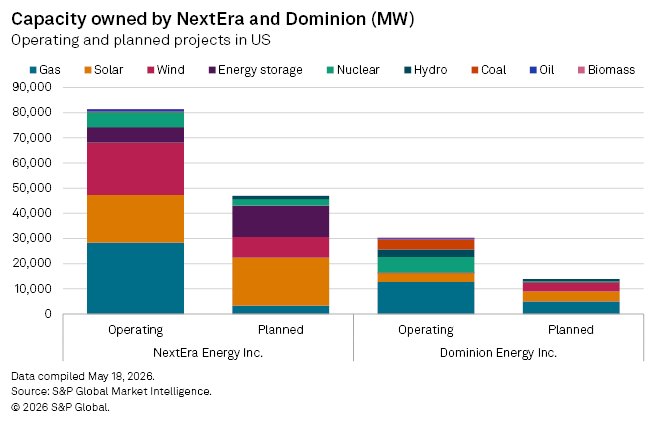
"Demand for electricity is increasing unlike anything we've seen in generations," NextEra Chairman, President and CEO John Ketchum said on a May 18 call to discuss the merger. "The opportunity set is enormous. Meeting it requires us to enhance our customer value proposition. That starts with scale."
Once the deal closes in 12 to 18 months, mid-scale utilities will compete for "secondary-tier or regional large-load customers while the premier national contracts route to the combined entity," Melius analysts said.
Dominion shares jumped 9.4% on May 18 to close at $67.56 in more than seven times average trading volume, while NextEra shares fell about 5% to settle at $89.04, also in heavy trading. Fitch Ratings, Moody's and S&P Global Ratings all reaffirmed NextEra's credit ratings on May 18.
Regulatory roadmap
The deal will require state-level approvals in North Carolina, South Carolina and Virginia, where Dominion serves retail electric customers, and is also subject to approval by the Federal Energy Regulatory Commission, the Nuclear Regulatory Commission and the expiration or termination of the waiting period under the Hart-Scott-Rodino Antitrust Improvements Act.
"The regulatory obstacles to closing the deal are the real variables in our view," analysts at Evercore wrote May 18.
CreditSights does not anticipate "strong regulatory pushback" at the state level, while Evercore noted that including $2.25 billion in bill credits spread out over a two-year period for Dominion's customers was "a prudent approach" that could "help facilitate the approval process."
Customer affordability was front and center during the 2025 Virginia gubernatorial election when Gov. Abigail Spanberger (D), who assumed the office in January, said during her campaign that companies should pay their fair share for grid upgrades needed to service large loads.
Washington Analysis director of policy research Rob Rains expects the merger to encounter "some fierce resistance" in Virginia.
"The three-member State Corporation Commission would be reviewing the deal under a net benefits test, so a settlement of some kind would be necessary to garner approval — and that still may not be enough," he wrote May 18.
Analysts at Jefferies, on the other hand, believe NextEra subsidiary NextEra Energy Resources LLC's 33-gigawatt backlog of renewable energy and storage projects could get the merger over the finish line.
"We could actually see NextEra as being welcomed in Virginia broadly with many stakeholders critical of Dominion for its focus on fossil fuels," Jefferies analysts said in a May 18 report, adding that focusing on energy storage development "could form a coalition of support; we believe this is a critical point that could make the deal approval process less bumpy than some other recent M&A deals."
Dominion Chair, President and CEO Robert Blue said during the May 18 call that NextEra's battery storage position could accelerate the company's "capital plan to meet Virginia's storage goals while removing capacity deficit and a reliance on the PJM market."
Legislation Spanberger signed into law on April 13 requires Dominion to petition the Virginia State Corporation Commission for "approval to construct, acquire, or procure" at least 16 GW of short-duration and 4 GW of long-duration energy storage projects by 2045, a significant increase from the current 3-GW-by-2035 requirement.
The merger would also enable NextEra to build more generation in PJM more "efficiently" than competitors, Ketchum said.